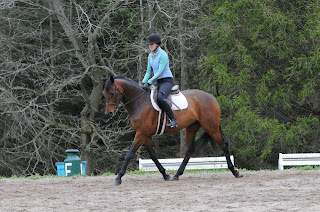
Forward. This is not new information for anyone who has had more than 2 riding lessons. A forward horse is the foundation on which everything else is built. And just to be clear, forward is not fast. Forward is a horse who is tracking up to the point where its back begins to swing. Ya, I made up that definition, but I feel like that's the best I can describe it to watch. To feel it, a forward horse is going the speed you dictate, *with ease*, and be able to move to different speeds with minimal effort from the rider. A truly forward horse is also "on your leg" - willing and able to collect, extend, go faster, or go slower, all at your own discretion.
The more I work with young horses, the more I realize the true importance of teaching a horse forwardness from the very beginning. And not only forward, but to be ON your leg, listening and reacting to every squeeze. A forward horse encourages loosening of the back, and, when ready, a light contact will often result in an easily-suppled horse.
You shouldn't ever have to kick your horse. If you feel like you have to, you should be using your spur or whip instead: ask, tell, DEMAND. Forward is oh-so important, and lightness to the leg is part of this. If you feel like taking contact slows your horse down, your contact is either too harsh, but it is more likely that your horse is not truly forward. Of course, this has to be trained - taking contact and using a light leg support, or a whip if necessary to teach them forward must always be maintained. However, if, with even a normal contact, you feel like you have to push and push and PUSH your horse into your hand, lighten the hand and just work on FORWARD.
On my own young horse, I made the mistake of taking too much contact, too soon, and I have been paying for it. It is so much easier to do things right the first time, but it is never too late to correct your mistake. I spent much of the summer huffing and pufffing, and sweating, and panting, pushing and tryyying to keep Flora moving even somewhat forward. Sure, she looked good. She was in a "frame". But could I collect to any extent? Not at all. Could I extend her stride without pumping my legs on her sides? Nope. Did she stay connected and in that "frame" if I even tried? Heck no. Did I feel like my leg was connected to my hand. No way.
I've spent all fall, and a lot of the summer fixing this mistake. As a previous blog will tell you, the George Morris clinic really helped me. But watching a few young horses I've worked with has solidified my position on this forward issue. Watching them with a rider who is trying to pull them into a frame, as they are barely jogging along and she is exhausted because she is pushing, pushing pushing... watching them go from walk to halt and dive onto the forehand... wow.
Sure, everyone knows their horse should be forward. But I'm not so sure they understand why, nor what the implications might be of not. A horse that is behind your leg, or not just not forward, stops much easier at a jump. It is more likely to be hollow in its back, causing soreness to its back and hind end. Asking for any type on movement on the flat becomes a complete chore. Finding and making distances to a jump becomes next to impossible.
Forward is the first step on the dressage training scale, and it's there for a reason (ok, so it says "Rhythm", but with "tempo and energy"- it's the same thing!). You cannot build without a solid foundation, and that is a forward horse. There should not be a such a thing as a lazy horse. If your horse is lazy, it's because it was not trained properly, to be sensitive to the leg, or you're not using your leg and external aids properly. And hey, don't take offence. I'm still fixing my mistake ;)
Sunday, December 2, 2012

Sunday, October 28, 2012
How George Morris Changed My Life
Two weeks ago, I attended the George Morris clinic held at Iron Horse Equestrian. Now, a little background on me and George Morris. When I was younger, I tried reading his famous 'Hunt Seat Equitation' book, but I'm more of a pictures kind of gal, and reading about riding has never been my thing. My friends and I were obsessed with his column in Practical Horseman, and would quote his famous sayings, like "this rider is jumping ahead of their horse and has allowed their lower leg to slip back", and so on. I always dreamed about sending a picture in, but I never had one that I felt 100% confident sending- apparently he will call you out for dirt on the soles of your boots! And then, when I was a working student in New Jersey, the trainer at the farm I was working at promised me a lesson with George, as he was supposedly only 10 minutes away. Obviously, that never happened.

So, when I heard George would be coming to teach a clinic that was only half an hour away, I jumped on the opportunity. Riding was not an option; not only did I not have $800 to spend on a couple of lessons, but Flora and I did not progress quite as much I had hoped this summer, and our fitness level was not nearly up to snuff.
I should have known George would start before the actual starting time. And, I won't lie: I squealed when I heard his voice. Like a little girl getting a dollhouse (or a toy barn, in my case) for Christmas. Like a keener, I brought my scribbler and pen, and started writing, because although I knew what he said would make sense at the time, I wanted to remember everything he said.
I should have known George would answer all my questions. For many, many years, I have struggled with the two point vs sitting question. When do you sit? When do you get up off their back? Is the answer discipline-related (hunter vs equitation vs jumper)? George explained that there was with the motion, and behind the motion- hopefully never ahead of the motion. With the motion was 2 point, and also 3 point. Now, I always assumed 3 point was the same as just sitting deep in the saddle, but it is not. 3 point is a way of sitting where your crotch has sunk into the saddle, and your base of support in your heels, inner calf, knee, and thigh- contact distributed evenly from calf to thigh, weight in heel, not seat. The two point is different in that your base of support becomes only your heels and calf- not your knee! He also pointed out that the upper body does not change much from 2 point to 3 point. He stressed getting forward in your 2 point, so you could balance yourself over your base of support. Leave it to George to be precise: "your upper body should be approximately 30 degrees in front of the vertical".
An interesting point for me was that your upper body should be the same in two point as it would be when you post the trot. George also stressed posting low to your horse and not "standing in your stirrups" at the 2 point, something I am most definitely guilty of. In George's opinion, 2 point was the jumping and galloping position, a very positive type of riding. 3 point was for "slow work" (flatwork, collection) and for sinking a few strides in front of a larger fence. George agreed that sitting (behind the motion) was useful in situations where you might need to really push your horse to a fence (like jumping a spooky liverpool).
A quote that also has changed me: "The first step to going forward is getting off their back and letting go". There have been times on Flora where I get so frustrated in her sucking back at the canter, that I get in the back seat, hold my hands like side reins, and drive her forward. Sure, she'll go forward, but she's none too happy about it. Her canter is so big, and she's so weak behind, though, that this isn't really getting me anywhere. She needs to WANT to go forward, so what I've figured out is that I need to get off her back and just make her GO. Only once she's forward and in front of my leg can I begin to ask her to go forward into my hand and then relax into it.
George was also very against "rubber-necking", the over-bending that has become very prevalent in most English disciplines. I found that I was also guilty of this. Even though we all KNOW about inside leg to outside rein is how things are supposed to go, we sometimes make exceptions and ride completely off the inside rein. Totally guilty here. George demonstrated keeping your hands together ( contact = straight, steady, definite, supple) and moving them together to move the shoulder with the hind end. For example, he showed that in the corners, instead of opening your inside rein to create a faux and over-bent horse, to move both hands to the outside (inside hand not crossing over the neck, though), and pushing with your inside leg, keeping your outside leg slightly back to balance.
This looked like it would work, so I tried it at home. What a difference!!! I'd been having trouble with Flora tilting and twisting her head, and getting very crooked, and could not figure out why. I now realize I'd simply been asking for too much and incorrect bend- through the neck, instead of through the ribcage, as I should have been. Since I've been concentrating on NOT over-bending, I've had a much straighter-in-the-neck, more-bent-in-the-body-when-told, more supple and happy horse. Really incredible. Likewise in the corners, he should how when circling, you move your hands to the inside, together (outside hand not crossing over the neck), push with your inside leg, and you end up with this nice bend around the circle, as the outside hand blocks the should from falling out and the inside leg bends the ribcage. If you keep your hands the proper space apart, your inside hand comes just enough to the inside for the neck to properly flex.
I realized I have been too easy on Flora, when it comes to forward and reactive. She is neither, and it is completely my fault. After watching and listening to George, who insisted on a forward and reactive (to your leg) horse, I realized my problem. He had a couple different ways of dealing with a lazy horse, and kicking was NEVER an option. When a student who had been standing in line, waiting their turn to jump, had a hard time getting their horse to move from the line, he would have them hold the reins in one hand and use the crop strictly behind the leg, at the halt. Let me tell you, they would be raring to go after that! He also had riders use quick jabs with their spurs as an "attack" to create more impulsion. If you didn't get a reaction after you asked nicely with your leg, you were to jab with the spur or use the crop. After adopting this with Flora, I have significantly more energy under me as I ride, and personally, more energy after I've ridden ;)

George was really incredible, and the last thing that has really changed my riding, was his theories on contact. Ideally, you want the horse to stretch, accept, and seek the hand. Of course, this is not always the case when you begin, as George demonstrated on a couple of particularly stubborn AA hunters that really quite enjoyed poking their nose out on a loose rein. For one, George hated anything that was not a steel bit, because it meant the horse did not truly accept that you would ever even use the bit.
When George asked for the horse to come into the bridle, he first used his legs. He made sure to be straight, steady, definite, and supple with his contact, and if the horse came up against the bit, he would increase his leg, raise his hands, and close his fingers more tightly around the reins. It sounded so simple, and most horses quickly gave in. Obviously, I thought he was genius as a rider. However, when I went to try this myself, I discovered how easily it worked! My automatic reaction to a horse coming above the bit would be to lower my hands, like draw reins. This reaction, though, is much more effective and correct.

It's not like any of this is revolutionary, right? I mean, we've all heard "outside rein, inside leg" and to ask then demand, in regards to your leg. But when you put it all together like this, it's really quite amazing. I've dug up my mom's old Hunt Seat Equitation book, and am definitely going to read it this time. I can't get enough of George, because he's truly changed my life :)

So, when I heard George would be coming to teach a clinic that was only half an hour away, I jumped on the opportunity. Riding was not an option; not only did I not have $800 to spend on a couple of lessons, but Flora and I did not progress quite as much I had hoped this summer, and our fitness level was not nearly up to snuff.
I should have known George would start before the actual starting time. And, I won't lie: I squealed when I heard his voice. Like a little girl getting a dollhouse (or a toy barn, in my case) for Christmas. Like a keener, I brought my scribbler and pen, and started writing, because although I knew what he said would make sense at the time, I wanted to remember everything he said.
I should have known George would answer all my questions. For many, many years, I have struggled with the two point vs sitting question. When do you sit? When do you get up off their back? Is the answer discipline-related (hunter vs equitation vs jumper)? George explained that there was with the motion, and behind the motion- hopefully never ahead of the motion. With the motion was 2 point, and also 3 point. Now, I always assumed 3 point was the same as just sitting deep in the saddle, but it is not. 3 point is a way of sitting where your crotch has sunk into the saddle, and your base of support in your heels, inner calf, knee, and thigh- contact distributed evenly from calf to thigh, weight in heel, not seat. The two point is different in that your base of support becomes only your heels and calf- not your knee! He also pointed out that the upper body does not change much from 2 point to 3 point. He stressed getting forward in your 2 point, so you could balance yourself over your base of support. Leave it to George to be precise: "your upper body should be approximately 30 degrees in front of the vertical".
An interesting point for me was that your upper body should be the same in two point as it would be when you post the trot. George also stressed posting low to your horse and not "standing in your stirrups" at the 2 point, something I am most definitely guilty of. In George's opinion, 2 point was the jumping and galloping position, a very positive type of riding. 3 point was for "slow work" (flatwork, collection) and for sinking a few strides in front of a larger fence. George agreed that sitting (behind the motion) was useful in situations where you might need to really push your horse to a fence (like jumping a spooky liverpool).
A quote that also has changed me: "The first step to going forward is getting off their back and letting go". There have been times on Flora where I get so frustrated in her sucking back at the canter, that I get in the back seat, hold my hands like side reins, and drive her forward. Sure, she'll go forward, but she's none too happy about it. Her canter is so big, and she's so weak behind, though, that this isn't really getting me anywhere. She needs to WANT to go forward, so what I've figured out is that I need to get off her back and just make her GO. Only once she's forward and in front of my leg can I begin to ask her to go forward into my hand and then relax into it.
George was also very against "rubber-necking", the over-bending that has become very prevalent in most English disciplines. I found that I was also guilty of this. Even though we all KNOW about inside leg to outside rein is how things are supposed to go, we sometimes make exceptions and ride completely off the inside rein. Totally guilty here. George demonstrated keeping your hands together ( contact = straight, steady, definite, supple) and moving them together to move the shoulder with the hind end. For example, he showed that in the corners, instead of opening your inside rein to create a faux and over-bent horse, to move both hands to the outside (inside hand not crossing over the neck, though), and pushing with your inside leg, keeping your outside leg slightly back to balance.
This looked like it would work, so I tried it at home. What a difference!!! I'd been having trouble with Flora tilting and twisting her head, and getting very crooked, and could not figure out why. I now realize I'd simply been asking for too much and incorrect bend- through the neck, instead of through the ribcage, as I should have been. Since I've been concentrating on NOT over-bending, I've had a much straighter-in-the-neck, more-bent-in-the-body-when-told, more supple and happy horse. Really incredible. Likewise in the corners, he should how when circling, you move your hands to the inside, together (outside hand not crossing over the neck), push with your inside leg, and you end up with this nice bend around the circle, as the outside hand blocks the should from falling out and the inside leg bends the ribcage. If you keep your hands the proper space apart, your inside hand comes just enough to the inside for the neck to properly flex.
I realized I have been too easy on Flora, when it comes to forward and reactive. She is neither, and it is completely my fault. After watching and listening to George, who insisted on a forward and reactive (to your leg) horse, I realized my problem. He had a couple different ways of dealing with a lazy horse, and kicking was NEVER an option. When a student who had been standing in line, waiting their turn to jump, had a hard time getting their horse to move from the line, he would have them hold the reins in one hand and use the crop strictly behind the leg, at the halt. Let me tell you, they would be raring to go after that! He also had riders use quick jabs with their spurs as an "attack" to create more impulsion. If you didn't get a reaction after you asked nicely with your leg, you were to jab with the spur or use the crop. After adopting this with Flora, I have significantly more energy under me as I ride, and personally, more energy after I've ridden ;)

George was really incredible, and the last thing that has really changed my riding, was his theories on contact. Ideally, you want the horse to stretch, accept, and seek the hand. Of course, this is not always the case when you begin, as George demonstrated on a couple of particularly stubborn AA hunters that really quite enjoyed poking their nose out on a loose rein. For one, George hated anything that was not a steel bit, because it meant the horse did not truly accept that you would ever even use the bit.
When George asked for the horse to come into the bridle, he first used his legs. He made sure to be straight, steady, definite, and supple with his contact, and if the horse came up against the bit, he would increase his leg, raise his hands, and close his fingers more tightly around the reins. It sounded so simple, and most horses quickly gave in. Obviously, I thought he was genius as a rider. However, when I went to try this myself, I discovered how easily it worked! My automatic reaction to a horse coming above the bit would be to lower my hands, like draw reins. This reaction, though, is much more effective and correct.
It's not like any of this is revolutionary, right? I mean, we've all heard "outside rein, inside leg" and to ask then demand, in regards to your leg. But when you put it all together like this, it's really quite amazing. I've dug up my mom's old Hunt Seat Equitation book, and am definitely going to read it this time. I can't get enough of George, because he's truly changed my life :)
Saturday, October 20, 2012
I'm Baaaaackkk!
I kept telling everyone that I would be back, and, finally, I am! A whole season later... but better late than never? So much to update y'all on, but 11pm on a Saturday night is not the time for it. Slash I don't want to write 50 billion pages all at once. Now that I have internet at my NEW HOUSE, hopefully it stays that way and this turbostick thing behaves better than it has tonight. So, this is it for now, but I promise to be back SOON and with something hopefully interesting to read!
Much love <3
Much love <3
Sunday, May 20, 2012
Essentially, My Pony is Amazing
Oh lordy, it's been a month since I last posted a blog. WHOOPS dropping the ball, just a bit. And, truth be told, I am completely defying what all my english teachers painfully tried to instill in me, and writing without a clue as to where it will end up. Ah well.
So, I think I left off at waiting for the Waylon clinic. Short version: Flora is actually amazing. I don't know how many times I can say it. She jumped bending lines, in and outs, and even the liverpool, no problemo. I always thought she'd be a hunter with her movement, look and attitude, but after the clinic, it was quite clear she was talented to do whatever I/she wants. SO PUMPED! I posted some pictures of her below, all courtesy of GRS and Emily Martin.



Afterwards, I started looking for shows to bring Flo to, and planning a fitness schedule for her. As my luck would have it, not only was the truck (a somewhat important part of the truck-and-trailer duo) stuck in Nova Scotia until June, but Flora decided she liked giving herself an excuse to shop for shoes. Aka pulling shoes like nobody's business. And THEN, I went on "vacation" for a week, and by vacation, I mean a visit-for-two-days-then-get-put-to-work-painting-and-cleaning-cation. Needless to say, Flo and I are less than ready for show season. Sigh.
I got home late last night and was wayy too exhausted to ride (plus, hey, what's one more day after 12?), so I put off my first ride back on Flo until today. It was realllly hot, at least for me. Thirty degrees is a bit above my comfort level in breeches, but I figured I may as well ride and start getting used to the heat. Miss Flo seemed to enjoy the attention of grooming and was even good for her bridle (she can be a bit a princess sometimes). I almost didn't lunge her, but figured that if I didn't want to die, that I probably should. I threw her on the lunge for all of about 3 minutes, which consisted of me chasing her into the canter, and her promptly breaking back into the trot, before deciding it was probably safe to get on.
No, seriously? How did I get such an amazing horse?! She wasn't just quiet, she was... like, pleasure hunter quiet. When I let her, she stretched her nose all the way to the ground and trotted around on the buckle. Then, after some nice canter work, I felt it for the first time... a REAL connection at the trot! FOR REAL!! And when I asked for the walk... she didn't raise her head and tighten her back in protest. Serious progress!! Let's hope it keeps up all summer... and maybe we'll make it to a few shows after all :)
So, I think I left off at waiting for the Waylon clinic. Short version: Flora is actually amazing. I don't know how many times I can say it. She jumped bending lines, in and outs, and even the liverpool, no problemo. I always thought she'd be a hunter with her movement, look and attitude, but after the clinic, it was quite clear she was talented to do whatever I/she wants. SO PUMPED! I posted some pictures of her below, all courtesy of GRS and Emily Martin.


Afterwards, I started looking for shows to bring Flo to, and planning a fitness schedule for her. As my luck would have it, not only was the truck (a somewhat important part of the truck-and-trailer duo) stuck in Nova Scotia until June, but Flora decided she liked giving herself an excuse to shop for shoes. Aka pulling shoes like nobody's business. And THEN, I went on "vacation" for a week, and by vacation, I mean a visit-for-two-days-then-get-put-to-work-painting-and-cleaning-cation. Needless to say, Flo and I are less than ready for show season. Sigh.
I got home late last night and was wayy too exhausted to ride (plus, hey, what's one more day after 12?), so I put off my first ride back on Flo until today. It was realllly hot, at least for me. Thirty degrees is a bit above my comfort level in breeches, but I figured I may as well ride and start getting used to the heat. Miss Flo seemed to enjoy the attention of grooming and was even good for her bridle (she can be a bit a princess sometimes). I almost didn't lunge her, but figured that if I didn't want to die, that I probably should. I threw her on the lunge for all of about 3 minutes, which consisted of me chasing her into the canter, and her promptly breaking back into the trot, before deciding it was probably safe to get on.
No, seriously? How did I get such an amazing horse?! She wasn't just quiet, she was... like, pleasure hunter quiet. When I let her, she stretched her nose all the way to the ground and trotted around on the buckle. Then, after some nice canter work, I felt it for the first time... a REAL connection at the trot! FOR REAL!! And when I asked for the walk... she didn't raise her head and tighten her back in protest. Serious progress!! Let's hope it keeps up all summer... and maybe we'll make it to a few shows after all :)
Thursday, April 19, 2012
It's Not Me, It's You.
You've heard it a million times, that horrible cliche, and if it has to be said, it's probably not true; "It's not you, it's me". But have you ever heard it the other way around? I actually have, but not in the sense that the original statement came from, and it's taken me a long time to realize how true it can be.
"It's not me, it's you". What I mean is, of course, in riding. This past week I've had a few mini breakthroughs with some of the horses I've been riding, and it's made me realize that sometimes you just have to wait it out, that sometimes you're not doing anything wrong- it's just taking some time for them to figure out what you're asking.
Sometimes, you need to set the ride, and stick to it. A young horse of mine used to bulge and twist and fall in and everything else you could imagine on a 20m circle, and it drove me crazy. I would get all caught up trying to fix each individual flaw- outside rein to block the shoulder, inside leg to bend his body around the circle, outside leg to keep the shape, and inside rein to get his nose just in slightly... and then repeat all steps at random intervals, as needed. It was extremely frustrating, and I could never seem to get THE perfect 20m circle with him. One day I gave up, set my body exactly how it would/should be around a 20m circle, and kept to that ride. And what happened?! He yielded and suddenly he was like a ping pong, bouncing around between my aids until he realized what he was supposed to do, and I finally got the circle I'd been looking for. All I'd needed to do was ask and wait.
Similarly, in lessons jumping young horses, I've been caught up in the push/pull, chip/long spot battle, where you can't seem to ever gain control or know what's going to happen in front of the fence, because everything is always changing.
In one instance, I was riding a huge, strong, and green baby. My coach told me to make him wait to the jumps, so I tried to keep him balanced between my hand and my leg to wait for a close distance. Instead, he took off about a stride early, and me, having been set to wait, got left behind. Never a pretty sight, right? I was embarrassed, but instead my coach said "No, that was the right ride. Come again and don't change a thing". So I did and hey! He waited! All it took was for him to not listen once and have to go through the uncomfortable event of me being left behind to realize it was better for him to not always make the decision.
"That was the right ride, do it again and don't change a thing", "put your leg on and wait", "Don't fuss, just keep your hands steady". It all means the same thing: have some confidence and some patience, because you're doing it right already, your horse just needs some time to figure it out. Sometimes it's not me, it's you :)
"It's not me, it's you". What I mean is, of course, in riding. This past week I've had a few mini breakthroughs with some of the horses I've been riding, and it's made me realize that sometimes you just have to wait it out, that sometimes you're not doing anything wrong- it's just taking some time for them to figure out what you're asking.
Sometimes, you need to set the ride, and stick to it. A young horse of mine used to bulge and twist and fall in and everything else you could imagine on a 20m circle, and it drove me crazy. I would get all caught up trying to fix each individual flaw- outside rein to block the shoulder, inside leg to bend his body around the circle, outside leg to keep the shape, and inside rein to get his nose just in slightly... and then repeat all steps at random intervals, as needed. It was extremely frustrating, and I could never seem to get THE perfect 20m circle with him. One day I gave up, set my body exactly how it would/should be around a 20m circle, and kept to that ride. And what happened?! He yielded and suddenly he was like a ping pong, bouncing around between my aids until he realized what he was supposed to do, and I finally got the circle I'd been looking for. All I'd needed to do was ask and wait.
Similarly, in lessons jumping young horses, I've been caught up in the push/pull, chip/long spot battle, where you can't seem to ever gain control or know what's going to happen in front of the fence, because everything is always changing.
In one instance, I was riding a huge, strong, and green baby. My coach told me to make him wait to the jumps, so I tried to keep him balanced between my hand and my leg to wait for a close distance. Instead, he took off about a stride early, and me, having been set to wait, got left behind. Never a pretty sight, right? I was embarrassed, but instead my coach said "No, that was the right ride. Come again and don't change a thing". So I did and hey! He waited! All it took was for him to not listen once and have to go through the uncomfortable event of me being left behind to realize it was better for him to not always make the decision.
"That was the right ride, do it again and don't change a thing", "put your leg on and wait", "Don't fuss, just keep your hands steady". It all means the same thing: have some confidence and some patience, because you're doing it right already, your horse just needs some time to figure it out. Sometimes it's not me, it's you :)
Wednesday, March 21, 2012
Fake it 'til you make it
Fake it 'til you make it. Did you laugh? I did the first time someone said that to me. But you know what? Everyone should do it. It sounds silly, and sounds like it will make you look silly... but it doesn't. If you've ever read or seen "The Secret" or have read any of Wayne Dyer's work (or the numerous positive thinking/holistic lifetsyle approach literature), you'd realize it's all the same; thinking positive, and thinking of yourself a certain way, until you actually become that way. Pretend to be happy for long enough, and you will actually become happy. Pretend you are a professional horseperson and real estate investor, and you will actually become so.
Now, I don't know if it's this crazy, awesome weather, or what, but things are really coming together for me. I remember during my last year of university, people asked me (my lord, how many times??) what I was going to do when I was done school. I told them I was going to ride, train and coach, and work flipping houses, both part time, and see which would take off first. It sounded kinda of silly, and I wasn't sure I even believed in myself. The last few months, I've been doing both sort of half-ass, yet not letting myself believe that either dream was over, either. All of the sudden (seemingly), I feel like a professional in both occupancies.
Between horses, I'm on the phone making appointments to see houses. I check out potential projects, or check up on current projects, sometimes throw on the painting clothes and paint for a few hours. Then I go home and spend the rest of the night working on budgets for potential projects. Today, I was told just how appreciated I was at my riding job, and that everyone was really happy with me. How nice is that?! I spent so long pretending to be a professional at both jobs (why else do you think I started this blog?), that I now feel like I've earned it. Would I compare myself to Ian Millar or Scott whathisface from Income Property? Hell no. But it's definitely a start :) Fake it 'til you make it, people! It's what I'm going to keep doing, and maybe one day I will, truly, "make it".
Now, I don't know if it's this crazy, awesome weather, or what, but things are really coming together for me. I remember during my last year of university, people asked me (my lord, how many times??) what I was going to do when I was done school. I told them I was going to ride, train and coach, and work flipping houses, both part time, and see which would take off first. It sounded kinda of silly, and I wasn't sure I even believed in myself. The last few months, I've been doing both sort of half-ass, yet not letting myself believe that either dream was over, either. All of the sudden (seemingly), I feel like a professional in both occupancies.
Between horses, I'm on the phone making appointments to see houses. I check out potential projects, or check up on current projects, sometimes throw on the painting clothes and paint for a few hours. Then I go home and spend the rest of the night working on budgets for potential projects. Today, I was told just how appreciated I was at my riding job, and that everyone was really happy with me. How nice is that?! I spent so long pretending to be a professional at both jobs (why else do you think I started this blog?), that I now feel like I've earned it. Would I compare myself to Ian Millar or Scott whathisface from Income Property? Hell no. But it's definitely a start :) Fake it 'til you make it, people! It's what I'm going to keep doing, and maybe one day I will, truly, "make it".
Thursday, March 8, 2012
The Importance of the Leg Yield
Oh, the leg yield. Seemingly so simple, it's included in the First Level dressage tests all over North America. Many people take it for granted, and I used to be one of these people until the last few weeks. After spending several weeks trying to teach certain horses to bend to the inside AND keep the outside rein AND respect my leg, I am now a true believer.
The point of the leg yield is not, as one might think, to just go sideways. Yes, that is the final result, but it's not really the point. The point is that, in doing a leg yield correctly, you have achieved some of the most important goals in your riding.
A proper leg yield needs several things to happen cooperatively. The horse needs to move away (and therefore respect) your leg, use their inside hind to step under himself and into your outside rein, softly bend to the inside, giving on the inside rein, and accept the outside aids as guidance.
In my (very humble) opinion, as soon as a horse understands basic forward and steering aids, it is never too early to start teaching the leg yield. Not only does it strengthen the horse, but it softens them to your aids. If a horse respects your leg enough to move away when you softly ask them to go over, you can bet he will also respect your leg when you ask him to go more forward, or even push him further into your hand. Likewise, if the horse understands how to bend around your leg, you can bet your circles and corners will be much nicer.
The impact of working the leg yield is practically exponential. So get practicing :)
The point of the leg yield is not, as one might think, to just go sideways. Yes, that is the final result, but it's not really the point. The point is that, in doing a leg yield correctly, you have achieved some of the most important goals in your riding.
A proper leg yield needs several things to happen cooperatively. The horse needs to move away (and therefore respect) your leg, use their inside hind to step under himself and into your outside rein, softly bend to the inside, giving on the inside rein, and accept the outside aids as guidance.
In my (very humble) opinion, as soon as a horse understands basic forward and steering aids, it is never too early to start teaching the leg yield. Not only does it strengthen the horse, but it softens them to your aids. If a horse respects your leg enough to move away when you softly ask them to go over, you can bet he will also respect your leg when you ask him to go more forward, or even push him further into your hand. Likewise, if the horse understands how to bend around your leg, you can bet your circles and corners will be much nicer.
The impact of working the leg yield is practically exponential. So get practicing :)
Subscribe to:
Posts (Atom)